

 Price match for Trade accounts
 Click & Collect from Bridgwater or London
 Next Working Day Delivery - UK wide distribution
Pipe Clips & Covers
Rubber Lined Clip - 38 - 43Mm
Code:C1281
SKU:C1281

Overview
Rubber Lined Clip - 38 - 43Mm
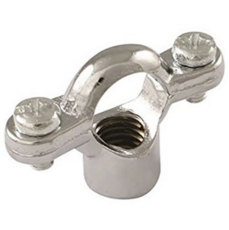
The Rubber Lined Clip (38 - 43mm) is a heavy-duty pipe support designed to secure medium-diameter pipework. The integrated EPDM rubber lining serves multiple critical functions: it prevents galvanic corrosion between different metals, dampens noise caused by vibration or thermal expansion, and provides a cushioned grip that protects the pipe surface.
Key Technical Specifications
Clamping Range: 38mm to 43mm (adjustable via twin side screws).
Connection Thread: Dual-threaded nut (typically M8/M10) on the back for mounting to threaded rods or backplates.
Material: Galvanized steel band for high strength and weather resistance.
Lining: EPDM rubber (UV and heat resistant).
Acoustic Insulation: Compliant with DIN 4109 for noise reduction in buildings.
Common Applications
Waste Pipes: Frequently used for 32mm (1 1/4") or 40mm (1 1/2") plastic waste pipes, where the rubber allows the pipe to expand and contract without "creaking."
Heating/Cooling: Securing copper or steel pipework where vibration from pumps needs to be isolated from the building structure.
Vertical Riser Support: Ideal for supporting vertical pipes in ducts or plant rooms.
Installation Best Practices
Mounting: Screw a length of M8 or M10 threaded rod into the welded nut on the back of the clip, and secure the rod to the wall or ceiling using a suitable anchor or backplate.
Pipe Placement: Open the clip by loosening the two side screws. Place the pipe inside and tighten the screws evenly.
Clamping Force: Do not over-tighten the side screws on plastic pipes; the pipe should be held firmly, but the rubber shouldn't be excessively compressed, especially on pipes that will undergo significant thermal movement.
Spacing: For 40mm waste pipes, clips should generally be spaced every 0.5m to 0.8m for horizontal runs and every 1.2m for vertical runs to prevent sagging.
You may also be interested in...
-
Information
The Rubber Lined Clip (38 - 43mm) is a heavy-duty pipe support designed to secure medium-diameter pipework. The integrated EPDM rubber lining serves multiple critical functions: it prevents galvanic corrosion between different metals, dampens noise caused by vibration or thermal expansion, and provides a cushioned grip that protects the pipe surface.
Key Technical Specifications
Clamping Range: 38mm to 43mm (adjustable via twin side screws).
Connection Thread: Dual-threaded nut (typically M8/M10) on the back for mounting to threaded rods or backplates.
Material: Galvanized steel band for high strength and weather resistance.
Lining: EPDM rubber (UV and heat resistant).
Acoustic Insulation: Compliant with DIN 4109 for noise reduction in buildings.
Common Applications
Waste Pipes: Frequently used for 32mm (1 1/4") or 40mm (1 1/2") plastic waste pipes, where the rubber allows the pipe to expand and contract without "creaking."
Heating/Cooling: Securing copper or steel pipework where vibration from pumps needs to be isolated from the building structure.
Vertical Riser Support: Ideal for supporting vertical pipes in ducts or plant rooms.
Installation Best Practices
Mounting: Screw a length of M8 or M10 threaded rod into the welded nut on the back of the clip, and secure the rod to the wall or ceiling using a suitable anchor or backplate.
Pipe Placement: Open the clip by loosening the two side screws. Place the pipe inside and tighten the screws evenly.
Clamping Force: Do not over-tighten the side screws on plastic pipes; the pipe should be held firmly, but the rubber shouldn't be excessively compressed, especially on pipes that will undergo significant thermal movement.
Spacing: For 40mm waste pipes, clips should generally be spaced every 0.5m to 0.8m for horizontal runs and every 1.2m for vertical runs to prevent sagging.
Product Enquiry
Please provide your contact information below and we will get back to you as soon as possible.